
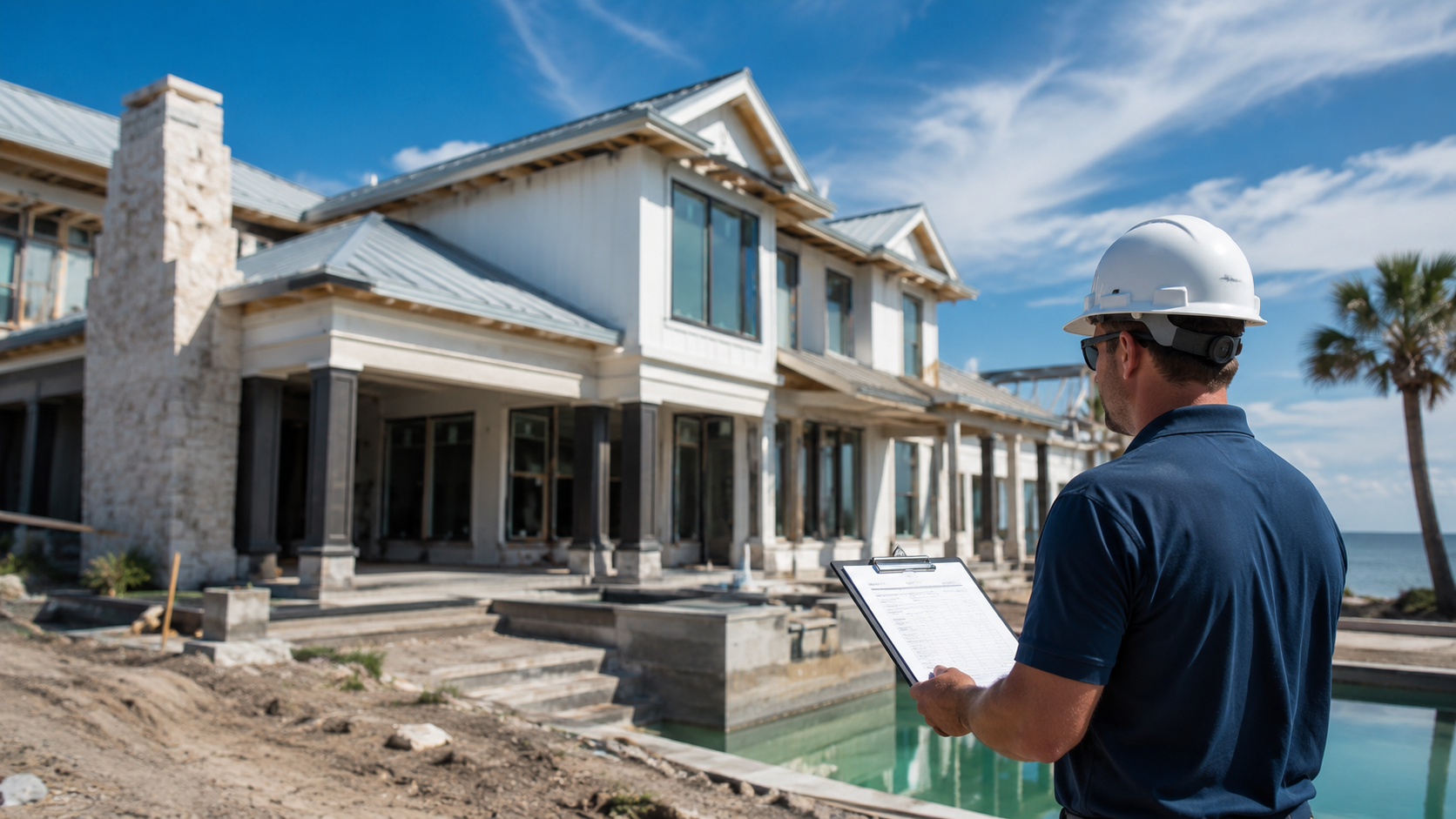
For high end home builders, wind mitigation in Jacksonville is not an upgrade package – it is code, and the same features that satisfy the Florida Building Code also drive the insurance credits that make a large coastal home affordable to carry. On a luxury build the stakes compound: more glass, longer roof spans, higher replacement cost, and often a parcel close enough to the water that both wind and flood requirements apply at once. Getting this right at design is far cheaper than retrofitting it later. Ofir Engineering is a licensed Florida general contractor (License #CGC 1540016) with 15+ years serving Jacksonville, Ponte Vedra, St. Johns, and Northeast Florida.
What the Code Requires of High End Home Builders in Jacksonville
Duval County and the surrounding Northeast Florida counties sit in a wind-borne debris environment for much of their area, with design wind speeds set by the Florida Building Code and mapped by location. That designation drives four requirements that shape a luxury home’s structure. Every glazed opening must be protected, either with impact-rated glass or with an approved shutter system. The roof must be attached to the walls, and the walls to the foundation, through a continuous load path of engineered connectors. Roof deck attachment must meet prescribed nailing patterns. And a secondary water barrier is required beneath the roof covering so that a lost shingle does not become a flooded interior.
Product approval is the detail that catches out-of-state builders. Windows, doors, roofing assemblies and shutters must carry Florida Product Approval or Miami-Dade Notice of Acceptance documentation, and the inspector will ask for it. The code text and approved product listings are published by the Florida Building Commission. Our article on Florida building code wind compliance covers the structural side in more depth.
Where Flood Requirements Layer On Top
Many of the parcels luxury buyers want – Ponte Vedra, the Intracoastal, riverfront lots in Duval and St. Johns – sit in Special Flood Hazard Areas, and flood rules are separate from wind rules. If your lot is in one, the lowest finished floor must be elevated to or above the base flood elevation, with local freeboard requirements often adding height beyond the federal minimum. Everything below that elevation is restricted in use, and any enclosure must have flood vents. Mechanical and electrical equipment has to be elevated too.
For a high end home, elevation is an architectural problem as much as a code one, because it affects entry sequence, garage placement, site grading and the relationship to the water view that motivated the purchase in the first place. Confirm your parcel’s flood zone and base flood elevation with the FEMA Flood Map Service Center before design begins. Our guide to flood zone luxury home planning covers how to design around it.
How Wind Mitigation Features Translate Into Insurance Savings
Florida law requires insurers to provide premium discounts for specific wind-resistant construction features, documented through a wind mitigation inspection. The features that earn credits are the same ones the code requires: roof covering compliance, roof deck attachment method, roof-to-wall connection type, roof geometry, secondary water barrier, and opening protection.
The magnitude matters more on a luxury home than on a typical one. Because premiums scale with replacement cost, the same percentage credit produces a much larger annual dollar saving on a high-value home – which is why wind mitigation features that look expensive at bid time frequently pay back over a reasonable holding period, and why they also support resale value by lowering the next owner’s carrying cost. Insurance requirements and consumer guidance for Florida are published by the Florida Office of Insurance Regulation. Our article on wind mitigation retrofit requirements explains the inspection itself.
The Luxury-Specific Design Tensions
Large expanses of glass are the defining feature of most high end coastal homes and the hardest thing to reconcile with wind design. Large impact-rated units are available but heavy, expensive and long-lead, and the structural openings around them require engineered headers and connections. Designing the glazing early, and ordering it early, is the difference between a schedule that holds and one that does not.
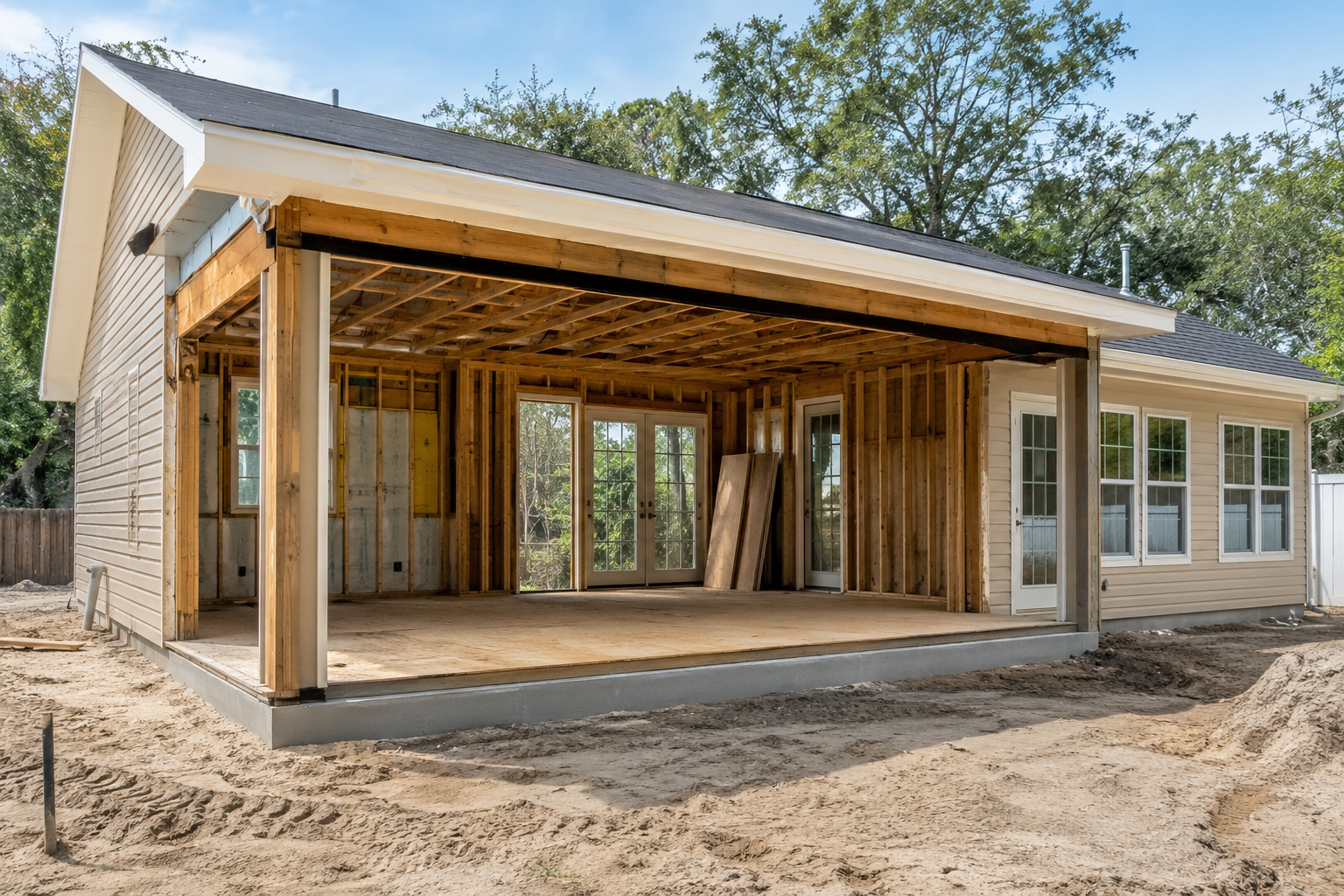
Complex roof geometry is the second tension. Architecturally interesting rooflines with multiple hips, valleys and dormers are harder to detail for wind resistance than simple forms, and a simple hip roof actually earns a better insurance classification than a complex or gable-heavy one. Outdoor living space is the third: summer areas, pool pavilions and covered terraces are essential to the luxury program in Florida and each one adds openings and roof edges that must be engineered rather than added on. Our hurricane resistant construction guide and our overview of impact windows for Florida homes go into the detailing.
What to Ask a Builder Before You Sign
Ask how they document product approvals and where those documents live at inspection time. Ask whether the structural engineer has designed the continuous load path for the specific glazing package, or whether the glazing was selected after the structure was designed – the second order produces expensive rework. Ask what the wind mitigation inspection is expected to report on completion, feature by feature, because that report is what your insurer will price from. Ask when long-lead impact openings are ordered relative to permit submittal.
And confirm the license. Ofir Engineering is a licensed Florida general contractor, License #CGC 1540016, and any contractor can be verified through the Florida DBPR license portal. Our luxury home builder team designs wind and flood compliance into the program from the first sketch; see also our guide to luxury home permits and inspections, or reach us through our contact page.
Frequently Asked Questions
Are impact windows required on a new Jacksonville luxury home?
Opening protection is required in wind-borne debris regions, and impact-rated glazing is the most common way to satisfy it. Approved shutter systems are the alternative. Which applies to your parcel depends on its mapped wind speed and location, so verify before design.
How much can wind mitigation features reduce insurance on a high-value home?
Florida insurers are required to give credits for documented wind-resistant features, and because premiums scale with replacement cost, the same percentage credit produces a much larger dollar saving on a luxury home than on an average one. Your wind mitigation inspection report determines the credits.
Does roof shape really affect my premium?
Yes. A hip roof generally earns a better wind classification than a gable-dominant or complex roof, because it performs better under uplift. On a luxury home this is a genuine trade-off between architectural expression and carrying cost, and it should be discussed at schematic design.
What if my lot is in both a wind-borne debris region and a flood zone?
Both sets of requirements apply independently. You will need opening protection and a continuous load path for wind, plus elevation above base flood elevation, flood vents in any enclosure below it, and elevated mechanical equipment for flood. Design for both from the start.
Keep Building With Ofir Engineering
Related discussions & follow us: Facebook · Reddit
Latest & related guides: Explore more Luxury Home Builder guides →