
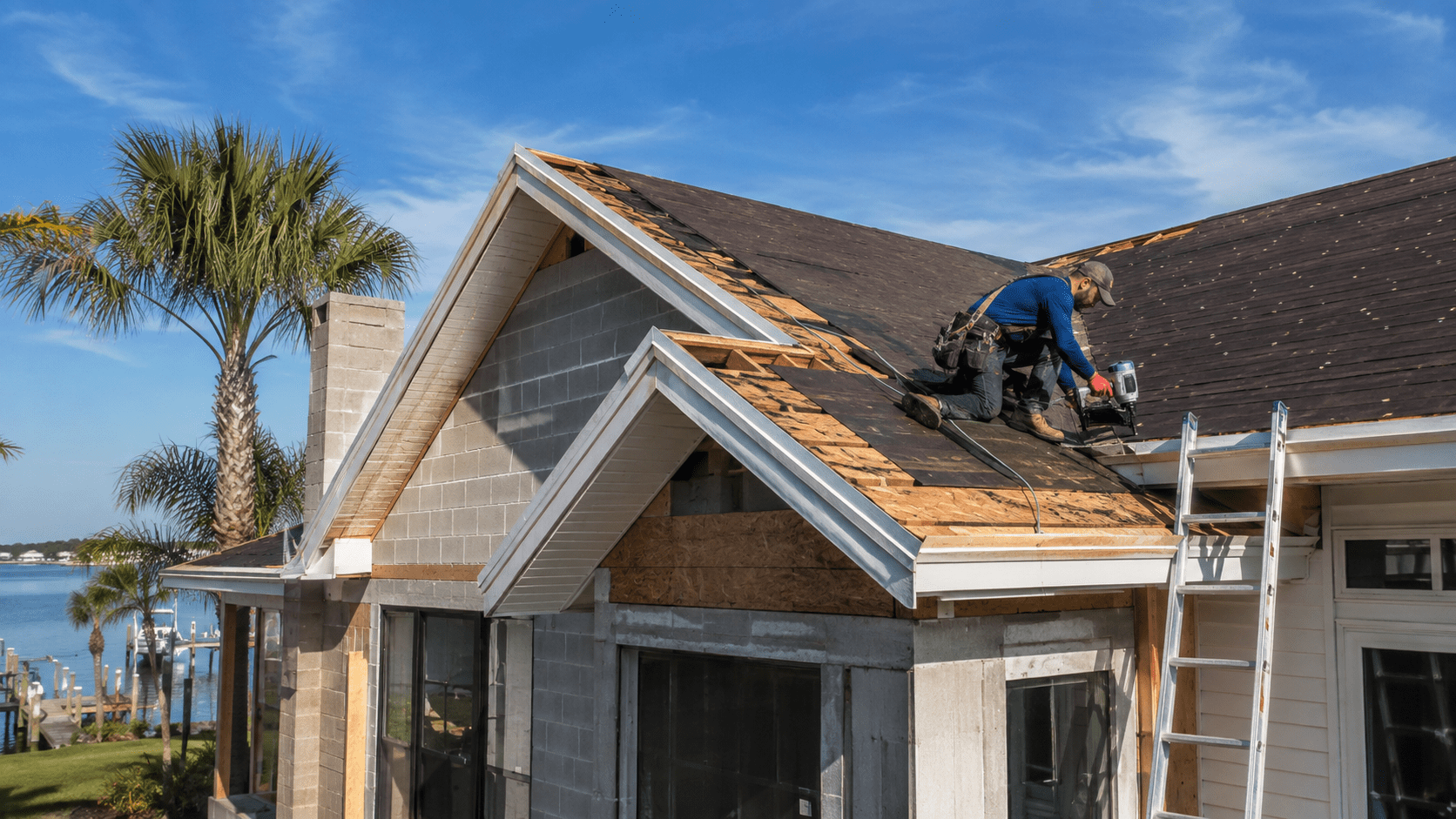
A contractor for home renovation wind mitigation project in Jacksonville is working against two rulebooks at once: the Florida Building Code, which decides what must be brought up to current standard once you open a wall or a roof, and the insurance rating system, which decides whether that work earns you a premium credit. Most homeowners discover the connection late, after the scope is priced. Handled deliberately, the same dollars that satisfy the code also move your policy. Ofir Engineering is a licensed Florida general contractor (License #CGC 1540016) with 15+ years serving Jacksonville, Ponte Vedra, St. Johns, and Northeast Florida.
What Wind Mitigation Means for a Contractor for Home Renovation
Wind mitigation is the set of construction features that keep a building envelope closed during a hurricane. Insurers do not rate them loosely — Florida law requires carriers to give discounts for specific, verifiable features, and those features are recorded on a standard inspection form completed by a qualified inspector. In practice, seven categories drive almost the entire credit: the age and code compliance of the roof covering, how the roof deck is fastened to the trusses, the roof-to-wall connection (toe nail, clip, single wrap, double wrap), the roof geometry (hip versus gable), the presence of a secondary water resistance barrier under the covering, and the level of opening protection on windows, doors and garage doors.
Every one of those is a construction decision, not a paperwork decision. A renovation that re-roofs without upgrading deck attachment, or that replaces windows without specifying impact-rated units, spends the money and earns nothing. That is why the mitigation conversation belongs in pre-construction, alongside the rest of your whole home remodeling scope, rather than at the inspection at the end.
The Code Triggers That Force an Upgrade
Renovations in Florida are governed by the Florida Building Code, Existing Building volume, and it works on triggers. Small repairs are treated as repairs. Once the work crosses a defined threshold, the assembly you touched has to comply with current requirements rather than the code in force when the house was built.
The trigger homeowners meet most often is the roof. When more than a quarter of a roof section is repaired, replaced or recovered within a twelve-month window, the code generally requires the entire roof section to be brought into compliance with current standards — which is where deck re-nailing and the secondary water barrier enter the scope. Structural alterations, additions and changes of occupancy carry their own triggers. So does any work that increases loads on existing framing.
The second trigger is the design wind speed for your specific address. Duval County sits in a high-wind region, and the required ultimate design wind speed rises as you move toward the ocean and the Intracoastal. It governs product approvals for windows, doors, roofing and garage doors, and it is the reason a component that is perfectly legal in an inland county can be rejected in Atlantic Beach. Product approval numbers are published by the state through the Florida Building Commission, and every specified component should carry one that covers your address.
Flood Zone Rules and the Fifty Percent Test
If the house sits in a mapped special flood hazard area, a second and stricter rule applies. When the cost of an improvement reaches half the market value of the structure, the work is classed as a substantial improvement and the whole building must be brought into compliance with current flood provisions — which usually means elevating the lowest floor above base flood elevation, using flood-resistant materials below that line, and providing compliant flood vents in enclosed areas.
This is the single largest budget risk in a coastal Northeast Florida renovation, because it is a cliff rather than a slope. A scope priced just under the threshold is an ordinary remodel; the same scope priced just over it can require elevation. It also compounds across permits: many jurisdictions look back over multiple improvements rather than judging each permit alone. Verify the flood zone and the base flood elevation before design is finished, not after — our guide to flood zone home construction in Northeast Florida walks through how the determination is made.

Which Upgrades Actually Reduce the Premium
Not all mitigation spending is rated equally. In practice, the two features that move a Florida wind premium the most are opening protection and the roof-to-wall connection.
Opening protection. Credit is given when every glazed opening is protected to the required impact standard — and it is all-or-nothing. One unprotected window, one unrated garage door, or an unprotected sliding door can forfeit the credit for the entire house. That is why the specification has to cover the garage door and any secondary entries, not only the front elevation. Our overview of impact windows for Florida homes covers the rating levels in detail.
Roof-to-wall connection. Older Jacksonville homes were commonly built with toe-nailed trusses. Upgrading to clips, or to single or double wraps, is the difference between the lowest and the highest credit tier in that category — and it is far cheaper to do while soffit or drywall is already open during a renovation.
Roof deck attachment and secondary water resistance. Re-nailing the deck to current fastener schedules and installing a sealed secondary barrier are typically inexpensive additions during a re-roof, and both are rated.
Roof covering compliance. A covering installed under current code with documented product approval is rated more favorably than an undocumented older one, which is why permit records matter as much as the shingles.
The practical rule: schedule the mitigation inspection after the work is permitted, inspected and closed, so the form reflects the finished condition. Credits are applied at renewal, so the payback is measured across years, not weeks. For a broader retrofit scope, see our guide to wind mitigation retrofit requirements in Jacksonville.
What to Require From Your Contractor
Ask for the flood determination and design wind speed for the address in writing before design is complete. Require product approval documentation for every exterior component. Ask which code triggers the scope will cross and what they add to the budget — a contractor who cannot answer that has not priced the real job. Confirm that permits are pulled and closed, because an unclosed permit undermines both the appraisal and the mitigation form. And make the mitigation inspection an explicit deliverable at closeout rather than something you arrange months later. To scope a renovation this way, contact Ofir Engineering.
Frequently Asked Questions
Does a home renovation in Jacksonville have to meet current wind code?
Only for the assemblies the work triggers. Minor repairs are treated as repairs, but once a roof section crosses roughly a quarter of its area within twelve months, or the work is a structural alteration or addition, that assembly must meet current requirements rather than the original code.
Will wind mitigation upgrades actually lower my insurance premium?
Florida carriers are required to credit specific verifiable features, so upgrades that appear on the standard mitigation inspection form do affect the wind portion of the premium. The size varies by carrier and by the features you achieve, and credits apply at renewal after the inspection is filed.
What is the fifty percent rule in a flood zone?
If improvement costs reach half the market value of the structure, the project is a substantial improvement and the entire building must comply with current flood provisions — typically elevating the lowest floor above base flood elevation and using flood-resistant materials below it. Many jurisdictions count improvements cumulatively.
Do I need to protect every window to get the opening protection credit?
Yes. The credit is assessed on the weakest opening in the building, so a single unprotected window, sliding door or garage door can forfeit it for the whole house. Protect every glazed opening to the same standard or the spend does not convert into a credit.
Keep Building With Ofir Engineering
Related discussions & follow us: Facebook · Reddit
Latest & related guides: Explore more Whole Home Remodeling guides →