
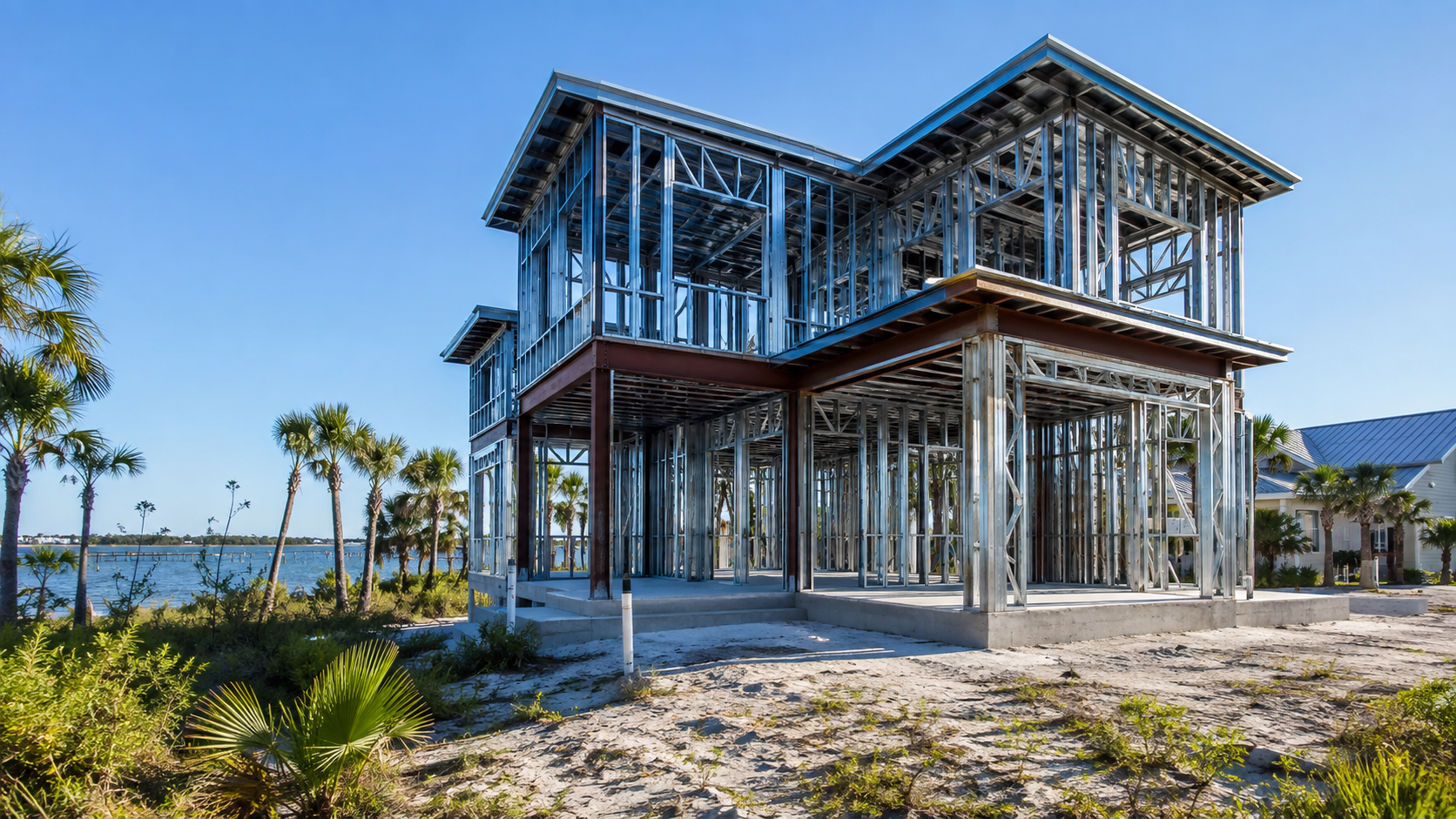
Comparing steel built homes to conventional construction on purchase price alone answers the wrong question. A house is owned for decades, and in a subtropical, storm-exposed market like Northeast Florida the costs that accumulate after the certificate of occupancy — insurance, maintenance, repairs, pest treatment, and storm recovery — often matter more than the difference in the original build. Ofir Engineering is a licensed Florida general contractor (License #CGC 1540016) building steel structures across Jacksonville, St. Johns, and Northeast Florida.
The Up-Front Premium on Steel Built Homes
Start honestly: a steel structure generally costs more to put up than an equivalent wood-framed one. The material prices higher per unit, the design requires a sealed engineering package, the connection hardware is a larger budget line, and erection may need a crane and a crew experienced with the system. Depending on the design and the market at the moment, the structural premium is real, though it narrows during lumber price spikes and narrows further when shop fabrication compresses the framing schedule and saves loan interest.
That premium is the number most comparisons stop at. The rest of this article is about what happens over the following thirty years. For the structural options themselves, see our steel home construction services.
Insurance and Storm Exposure
Florida homeowners feel insurance costs more sharply than owners in most states, and carriers price structural resilience. Wind resistance, roof performance, and opening protection all feed into what a policy costs and what deductible applies. A rigid, engineered steel frame with well-documented load paths is a structure built for wind, and steel does not burn, which matters to underwriters as well. Owners should confirm specifics with their own carrier, because policies vary, but the structural characteristics of a steel home are the kind that insurers evaluate favorably.
The related saving is storm recovery. The most expensive hurricane outcome is not a deductible; it is months of displacement, remediation, and repair. A structure that stays intact and dry through a wind event avoids a category of cost that never appears in a construction estimate.
Maintenance, Pests, and Moisture Over Decades
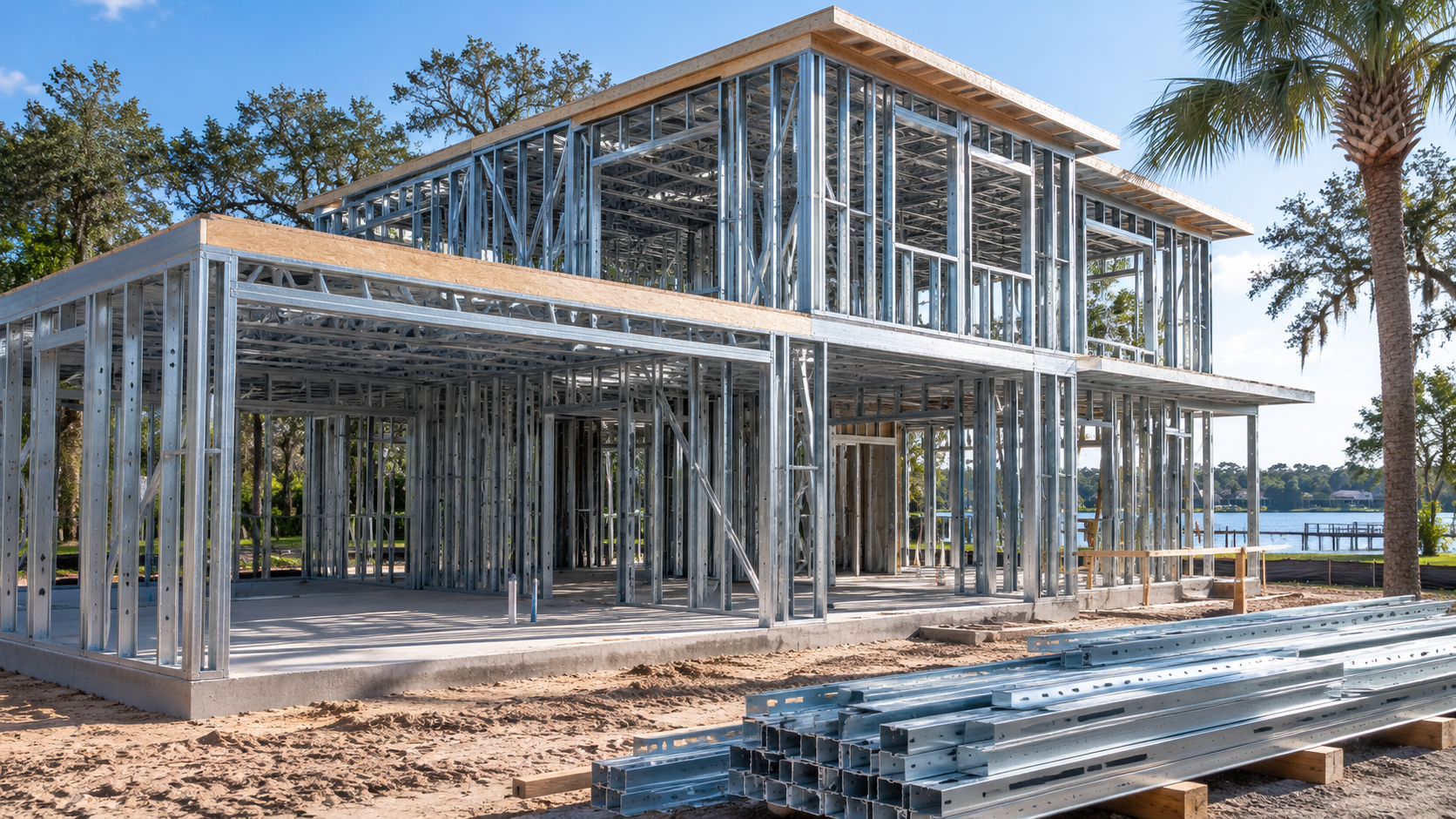
This is where steel’s ownership math is strongest. Steel does not rot, does not warp, does not shrink or twist with humidity, and termites and other wood-destroying organisms have no interest in it. In Northeast Florida, where subterranean termites are endemic and humidity is a constant, that removes an entire class of recurring cost and risk — repeat treatments, damage repairs, and the possibility of discovering structural damage years after it began.
Dimensional stability pays smaller dividends continuously. Frames that do not move seasonally produce fewer drywall cracks, fewer sticking doors, fewer nail pops, and fewer callbacks. Over decades those are modest individually and meaningful in aggregate. Steel is also fully recyclable at end of life and is commonly made with substantial recycled content, which matters to owners weighing environmental cost alongside financial cost.
Energy Performance: the One Line That Needs Attention
Steel’s weakness is thermal conductivity. A steel-framed wall detailed like a wood wall will underperform, because the members conduct heat straight through the assembly. Handled properly — continuous exterior insulation, thermal breaks, or an insulated panel system — a steel home performs at least as well as its wood counterpart, and the tight, stable envelope helps a properly sized HVAC system control humidity. Handled improperly, it costs money every month for the life of the house. Practical guidance on envelope performance is available through the U.S. Department of Energy’s Energy Saver program.
The takeaway is that the insulation strategy is not an upgrade to consider later; it is part of the structural decision. Our steel frame construction team details the thermal package with the frame rather than after it.
Running the Comparison for Your Own Situation
To compare fairly, put both options on a thirty-year sheet. On the build side, include the structural premium, the engineering fee, and any schedule savings from shop fabrication. On the ownership side, include insurance, expected pest control and wood-repair exposure, maintenance and callback patterns, energy cost under a properly detailed envelope, and a realistic view of storm risk for your parcel. For many Northeast Florida owners — particularly on coastal or exposed sites, and particularly for those planning to hold the home long term — the durability side of the ledger closes much of the up-front gap.
It is not automatically the right answer for everyone. A short holding period, a sheltered inland lot, and a simple rectangular design all argue for conventional framing. When you want the comparison run on your actual plans, contact Ofir Engineering and we will price both. As a licensed general contractor, License #CGC 1540016, we build to code and stand behind the work.
Frequently Asked Questions
Do steel built homes cost more than wood-framed homes?
Generally yes on the structure itself — the material, the sealed engineering package, connection hardware, and erection all price higher. The gap narrows during lumber price spikes and narrows further when shop fabrication shortens the framing schedule and saves construction-loan interest.
Do steel homes lower insurance costs in Florida?
Carriers price structural resilience, and a rigid engineered steel frame with documented load paths and non-combustible structure is the kind of construction underwriters evaluate favorably. Policies vary, so confirm specifics with your own carrier before assuming a figure.
What maintenance do steel built homes avoid?
Steel does not rot, warp, shrink, or feed termites, which removes recurring treatment costs, wood-damage repairs, and the risk of hidden structural decay — all meaningful in a humid, termite-endemic region. Dimensional stability also means fewer drywall cracks and sticking doors over time.
Are steel homes energy efficient in a hot climate?
They are when detailed correctly. Steel conducts heat, so continuous exterior insulation or engineered thermal breaks are essential; done properly the assembly performs at least as well as wood, and the tight, stable envelope helps HVAC control humidity. Skipping that detailing costs money every month.
Keep Building With Ofir Engineering
Related discussions & follow us: Facebook · Reddit
Latest & related guides: Explore more Steel Frame Construction guides →