
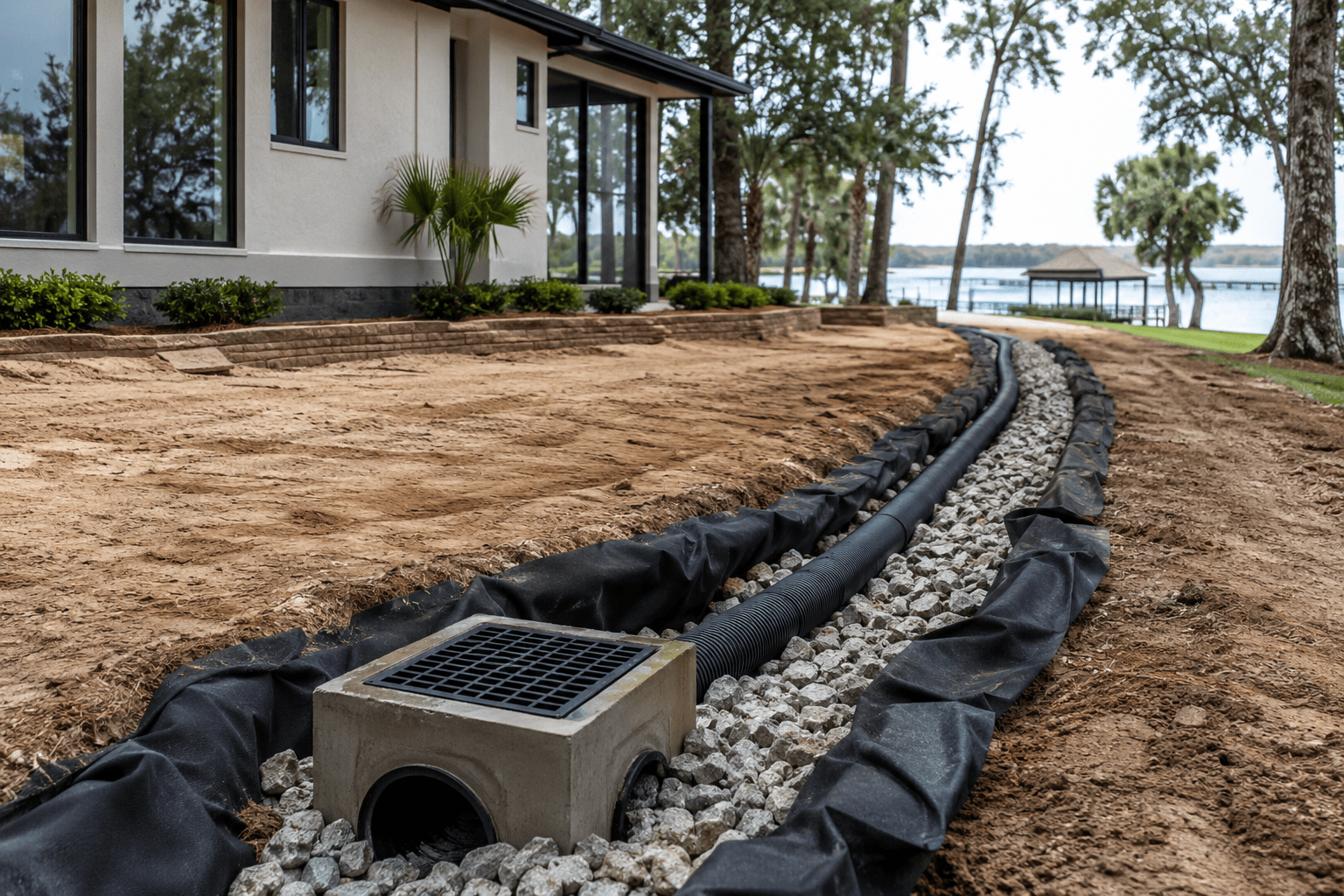
For a build to rent builder, soil and drainage are not a due-diligence formality in Northeast Florida — they are the constraint that decides unit count, foundation type and whether a site pencils at all. Two adjacent parcels with the same zoning and the same acreage can carry very different densities once the water table, the soil profile and the stormwater requirement are measured. Investors who price a BTR site from the zoning map alone are pricing a building the lot may not support. Ofir Engineering is a licensed Florida general contractor (License #CGC 1540016) with 15+ years serving Jacksonville, Ponte Vedra, St. Johns, and Northeast Florida.
What Build to Rent Builder Soil and Drainage Diligence Involves
Site diligence for a rental community answers four questions in order, and each one can change the answer to the next.
What is the soil profile? A geotechnical report with borings across the parcel tells you the bearing capacity, the depth of any unsuitable material and whether organic or highly compressible layers sit under the building pads. Northeast Florida is largely sandy, which often bears well, but pockets of peat, muck and old fill are common near creeks, former wetlands and previously developed sites.
Where is the seasonal high water table? This governs far more than the foundation. It determines whether a stormwater pond can hold water, whether a retention system can infiltrate, and how much fill is needed to build a pad at a workable elevation.
How does water leave the site? Every parcel has a legal outfall — the point where stormwater is permitted to discharge. If there is no viable outfall, the site must retain its own water, which consumes land you had counted as rentable.
What is the flood status? A parcel inside a mapped special flood hazard area carries elevation, materials and venting requirements that change both cost and finished floor heights across the whole community. Flood determinations are published through FEMA flood maps, and our guide to flood zone construction in Northeast Florida explains how the determination is applied.
How Soil Changes the Foundation and the Budget
Once the borings come back, the foundation strategy follows. Clean sand at a suitable bearing depth supports conventional slab-on-grade or stem-wall foundations, which is the least expensive outcome. Marginal soils typically mean over-excavating the unsuitable material and replacing it with engineered, compacted fill — a cost that scales with the depth and area of the bad material, and one that is very expensive to discover after closing on the land. Genuinely poor soils push you toward deep foundations, pilings or ground improvement, which changes the structural design of every building on the site.
High groundwater compounds all of this, because a pad has to sit far enough above it to keep the sub-slab dry, and fill must be trucked in and compacted in lifts. On a single house that is a line item. Across a community of dozens of units it is a major budget category, and it is the reason two BTR sites with identical purchase prices can have very different real land costs. Our overview of foundation types for Florida homes sets out how each system is selected.
Drainage and Stormwater: the Density Question Nobody Prices
Florida regulates both the rate and the quality of stormwater leaving a developed site. Because a BTR community converts open ground into roofs, drives and parking, it generates far more runoff than the raw parcel did, and that increase must be captured, treated and released at a controlled rate. In practice that means a pond, an exfiltration system or an equivalent, sized by engineering rather than by preference, and permitted through the water management district in addition to the local building department.
The consequence is direct: stormwater infrastructure consumes developable land. A site that looked capable of a certain unit count on a zoning calculation may lose a meaningful share of its buildable area to treatment and required setbacks around it. On flat parcels with a high water table — common across Duval, Clay and St. Johns — ponds must be wider and shallower to work, which consumes more area still.
Grading is the other half of the problem. A rental community has to move water away from every building, across drive aisles and amenity areas, to the treatment system without ponding at doorways or eroding the slopes. Getting positive drainage at every unit is a design discipline, and it is far cheaper to solve on the civil drawings than with corrective work after the first heavy season. The full scope of that coordination sits within our commercial construction practice, and our build-to-rent construction guide for Jacksonville investors covers the delivery model.
The Diligence Sequence That Protects the Deal
Order the geotechnical report during the inspection period, not after closing. Get a flood determination and the base flood elevation for the specific parcel. Have a civil engineer produce a conceptual grading and stormwater layout before you finalise unit count, so the density in your model reflects the land that will actually remain. Confirm there is a legal outfall and that utilities can reach the site. Check wetland presence and any required survey, since a wetland line can remove buildable area entirely. And confirm the parcel’s zoning permits the density you are underwriting before any of the above is spent.
Every one of those items is inexpensive relative to the land. Each one, discovered late, has ended otherwise sound Northeast Florida rental projects.
Frequently Asked Questions
What soil report does a build to rent project need?
A geotechnical report with borings distributed across the parcel, reporting bearing capacity, the depth of unsuitable or organic material, and the seasonal high groundwater elevation. It should be ordered during the inspection period, before the land is committed.
How does the water table affect a Northeast Florida lot?
It sets how much fill is required to build a workable pad, whether a retention system can infiltrate, and how wide and shallow a stormwater pond must be. High groundwater increases both fill cost and the land area consumed by treatment.
How much land does stormwater treatment take on a rental community?
Enough to change the unit count. Because roofs and paving increase runoff, the site must capture, treat and release it at a controlled rate, and the pond or exfiltration system plus its setbacks come out of otherwise rentable area — which is why a conceptual civil layout should precede the density assumption.
Can poor soil stop a project outright?
Rarely outright, but it can change the economics decisively. Marginal soils mean over-excavation and engineered fill; genuinely poor soils push toward deep foundations or ground improvement, which alters the structural design of every building on the site.
Test the Lot Before You Underwrite It
Soil and drainage decide what a Northeast Florida parcel can actually carry. If you are evaluating a build-to-rent site in Jacksonville or the surrounding counties, contact Ofir Engineering to review the geotechnical findings, the stormwater concept and the realistic unit count before you close.
Keep Building With Ofir Engineering
Related discussions & follow us: Facebook · Reddit
Latest & related guides: Explore more Commercial Construction guides →