
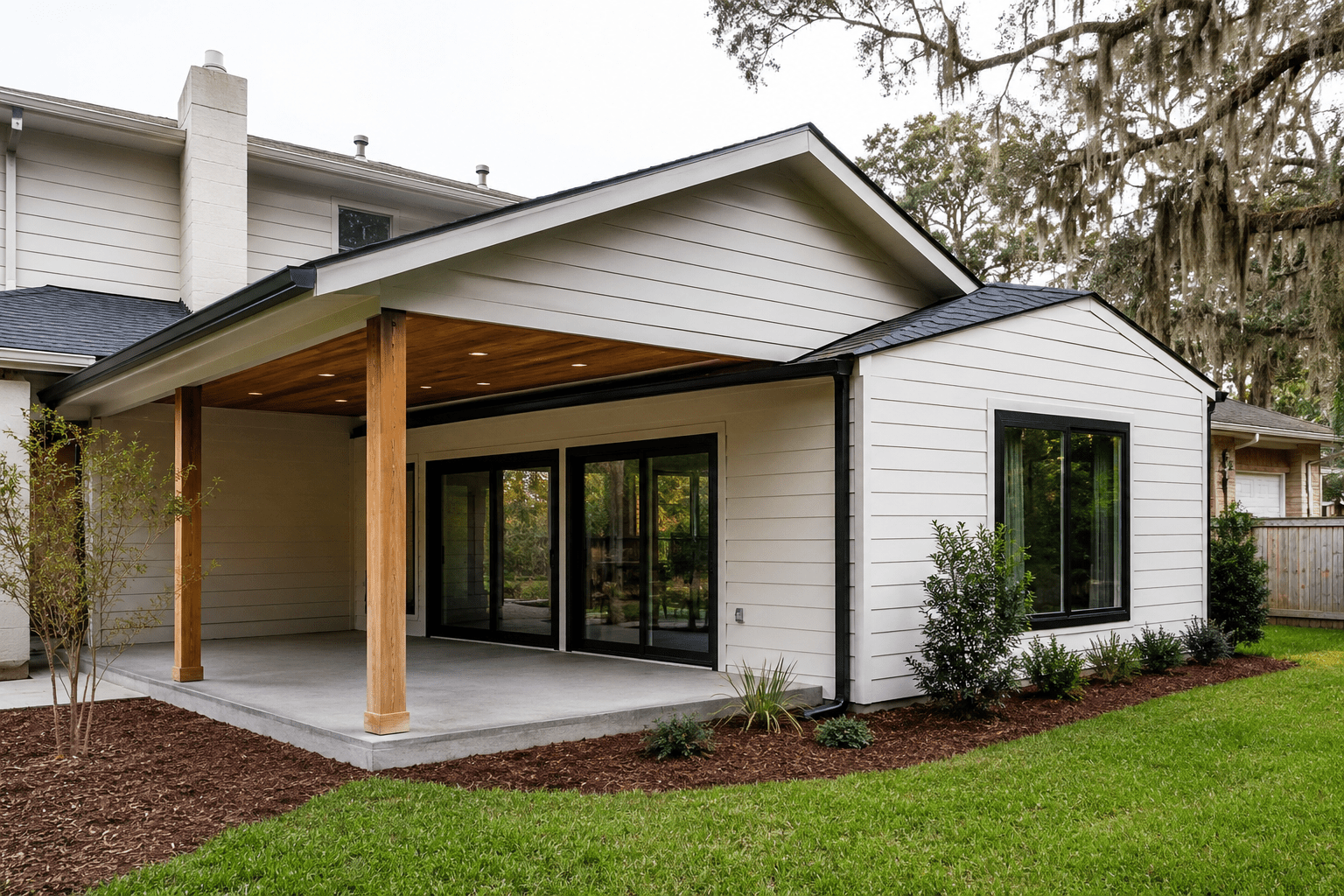
When homeowners search for home addition builders near me, contract terms are usually the last thing they compare and the first thing that matters when a project goes sideways. An addition is new construction fastened to a house you live in, and the contract is the only document that decides what happens when the schedule slips, the price moves or the work is not what you expected. In Florida, several of the protections that matter most are ones you have to ask for. Ofir Engineering is a licensed Florida general contractor (License #CGC 1540016) with 15+ years serving Jacksonville, Ponte Vedra, St. Johns, and Northeast Florida.
Before the Contract: What to Verify
Confirm the licence first. An addition is structural work requiring a licensed Florida general contractor, and licence status, the licensee’s name and any disciplinary history are all public through the Florida DBPR licence portal. Check that the name on the licence matches the name on the contract — a common problem is a contract signed with a marketing entity while a different licensed individual pulls the permit.
Then confirm insurance: general liability and workers’ compensation, on a certificate sent directly by the insurer’s agency rather than forwarded by the builder. And confirm who will pull the permit. Under Florida law an owner can pull an owner-builder permit, but a builder who asks the homeowner to do so is shifting code responsibility and liability onto you. That request is a reason to walk away.
The Home Addition Builders Near Me Contract Terms That Matter Most
A scope written as inclusions and exclusions. The most expensive disputes in additions come from things nobody wrote down: who patches and repaints the existing rooms disturbed by the tie-in, who re-sods the yard the excavator crossed, whether the existing HVAC is being extended or replaced, whether the existing electrical panel has capacity or needs upgrading. A scope that lists what is not included is worth more than one that only lists what is.
Allowances stated with real numbers. Allowances for flooring, fixtures and finishes should carry a specific dollar figure per unit and state what happens to the difference in either direction. Vague allowances are the standard mechanism by which a fixed price becomes a moving one.
A payment schedule tied to completed milestones. Payments should follow verifiable progress — permit issued, foundation poured and inspected, framing complete and inspected, dried-in, rough inspections passed, substantial completion — not calendar dates. Florida limits how much can be collected up front on residential improvement contracts, and a large deposit relative to the contract price is a warning sign in itself. Never let payments run ahead of the work in place.
A written change-order process. Every change should be priced and signed before it is built, with its schedule effect stated. Verbal changes are the second-largest source of addition disputes after undefined scope.
Dates and consequences. A commencement date, a substantial completion date, defined excusable delays, and what happens if the date is missed. “Weather” as an unlimited excuse is not a schedule.
Lien Protection: the Part Florida Homeowners Skip
Florida’s Construction Lien Law lets subcontractors and material suppliers place a lien on your home if they are not paid — even when you have already paid your contractor in full. This is the single largest financial exposure in a residential addition, and the protections are procedural.
Expect to receive a Notice to Owner from subcontractors and suppliers early in the job; that notice is not an accusation, it is the law working as intended, and you should keep every one. Then require lien releases with each payment: partial releases from the contractor and from every party who sent a Notice to Owner, covering the work paid for to date, and a final release from all of them before the final payment. Contractors are also required to give homeowners a written explanation of lien-law rights in qualifying contracts — if you were not given one, ask why.
The rule of thumb is simple: never make a payment without receiving releases covering the previous one, and never make the final payment until every release is in hand and the permit is closed.
Warranty, Closeout and the Existing House
An addition contract should state the workmanship warranty period and how a warranty claim is made, and it should pass through manufacturer warranties on roofing, windows and equipment. Separately, it should address the seam between new and old: how the roofline, foundation and finishes tie in, and who is responsible if settlement or water intrusion appears at that junction later. This is where additions most often fail, and where a contract is most often silent.
Require closeout as a deliverable, not a favour: a closed permit with all inspections passed and a Certificate of Occupancy or completion for the new space, plus the final lien releases and warranty documentation. An unclosed permit follows the house and surfaces during a sale. See our guide to home addition permits and inspections in Florida, our step-by-step addition process, and the full scope of our home additions service.
Frequently Asked Questions
How much deposit should a home addition contractor ask for?
A modest one. Florida limits up-front collection on residential improvement contracts, and payments should follow completed, inspected milestones. A large deposit relative to the contract price, or payments running ahead of the work in place, is a warning sign.
Can a subcontractor lien my house if I already paid the contractor?
Yes. Under Florida’s Construction Lien Law an unpaid subcontractor or supplier can lien the property even when the owner has paid in full, which is why lien releases should be collected with every payment and a full set of final releases obtained before the last one.
Should I pull the permit myself as the owner?
No. Florida allows an owner-builder permit, but a licensed contractor who asks you to pull it is transferring code responsibility and liability to you. The contractor performing the work should pull the permit.
What is the most common gap in an addition contract?
Undefined scope at the seam between new and existing — patching and repainting disturbed rooms, extending versus replacing HVAC, panel capacity, and responsibility for settlement or water intrusion at the tie-in. A scope that lists exclusions prevents most of these disputes.
Sign a Contract That Protects You
A clear contract is not an obstacle to a good addition; it is what a good builder wants in place. If you are planning an addition in Jacksonville or Northeast Florida, contact Ofir Engineering to review scope, milestones, lien protections and closeout before you sign anything.
Keep Building With Ofir Engineering
Related discussions & follow us: Facebook · Reddit
Latest & related guides: Explore more Home Additions guides →