
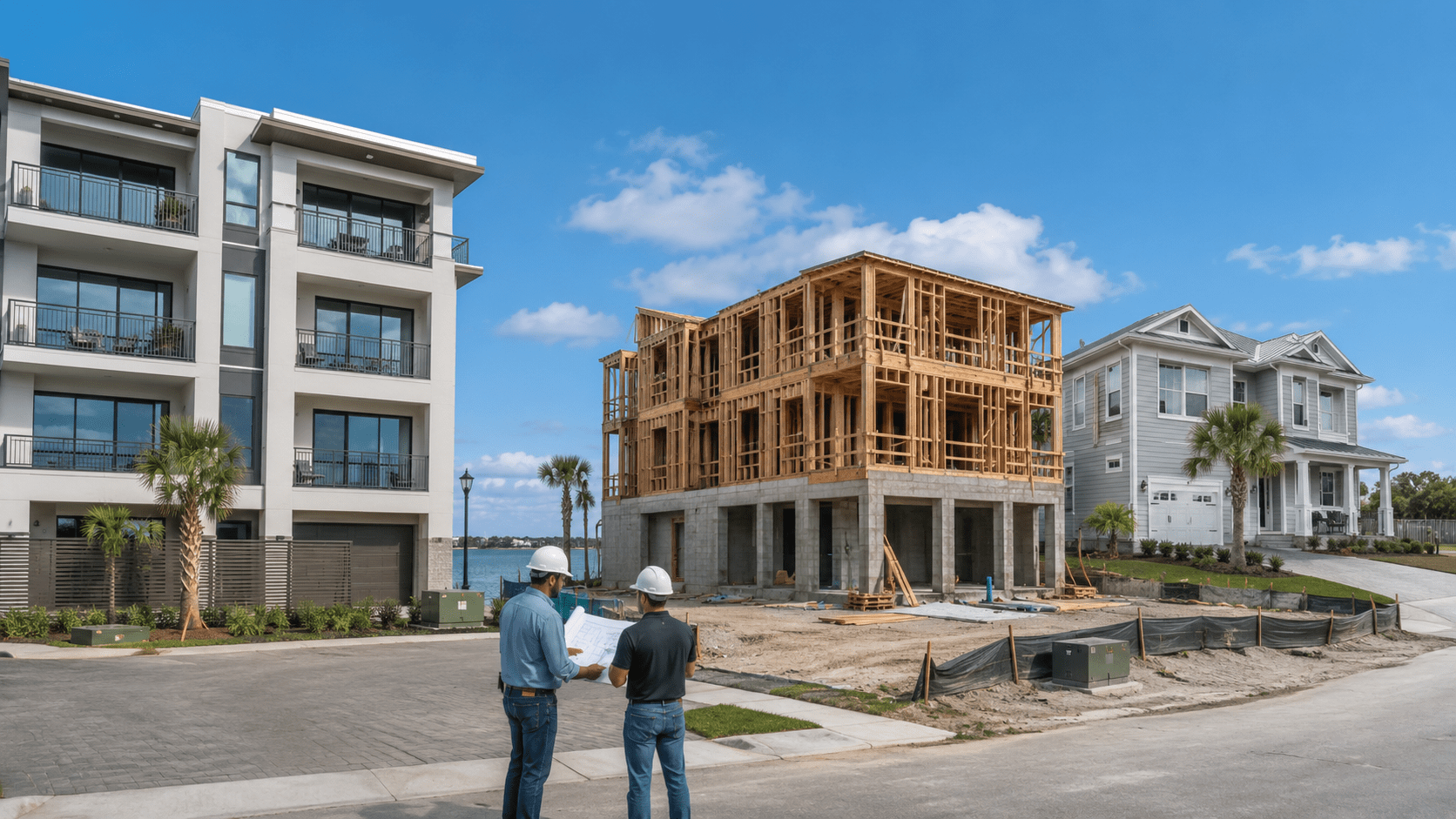
The apartment builder versus alternatives decision comes down to a single question most Jacksonville investors answer too late: are you buying a building, or are you buying control over what the building becomes? Hiring a builder to construct new units is not automatically the cheaper path, and it is not automatically the more expensive one either. It is cheaper in some situations and clearly worse in others, and the variables that decide it are knowable before you spend anything. Ofir Engineering is a licensed Florida general contractor (License #CGC 1540016) with 15+ years serving Jacksonville, Ponte Vedra, St. Johns, and Northeast Florida.
The Four Paths on the Table
Hire an apartment builder for ground-up construction. You buy or already hold land, and a licensed general contractor delivers a permitted, code-current building to a Certificate of Occupancy under one contract and one schedule.
Buy an existing apartment property. You acquire income on day one and inherit whatever condition, code vintage and deferred maintenance came with it.
Buy and reposition. You acquire an older building and renovate it — a middle path that trades construction risk for discovery risk.
Act as your own contractor and hire subcontractors directly, keeping the general contractor’s fee.
Each of these has a defensible case. The mistake is choosing on the headline number — price per unit, or price per square foot — when the real differences sit in schedule, financing, code exposure and who absorbs the surprises.
When an Apartment Builder Is the Cheaper Choice
Ground-up construction wins on cost more often than investors expect, and it wins in identifiable conditions.
When you already control suitable land. If the lot is already yours and zoned for the density you want, the acquisition cost that makes new construction look expensive is already sunk. From there you are comparing construction cost against an existing building’s purchase price plus its repairs.
When the existing stock in your target area is old. Northeast Florida has a large inventory of pre-code multifamily. An older building will not carry current wind-load construction, current roof-to-wall connections, current impact protection or a modern envelope. That shows up permanently in the insurance premium and in maintenance, and it is not a one-time repair line.
When you intend to hold. New construction front-loads cost and back-loads maintenance. Over a long hold, a new roof, new mechanical systems and a warranted structure suppress the capital expenditure curve for years.
When the unit mix matters to your rents. You cannot change the bones of an existing building cheaply. If your market rewards a specific unit mix or layout, building it is often less expensive than gutting a building to approximate it. Our custom home and ground-up construction team prices these comparisons at the pre-construction stage, before land is committed.
When It Is Not the Cheaper Choice
Building is the wrong answer when time is the binding constraint. An existing property produces rent the month you close; a ground-up project produces nothing until it is finished, and design, permitting and construction all sit ahead of that date. If your model needs income immediately, or your financing carries a short fuse, the carrying cost of a construction timeline can exceed everything you saved in construction.
Building is also the wrong answer when the land will not cooperate. A parcel that needs extensive fill, deep foundations, a stormwater pond you did not budget, or that sits in a flood zone requiring elevation can consume the entire advantage before the slab is poured. Verify soil, drainage and flood status before you buy — see our guide to flood zone construction in Northeast Florida.
And it is the wrong answer when the zoning is not already there. Rezoning or seeking a density variance is a public process with a real chance of failure. If the entitlement is speculative, the risk-adjusted cost of building is much higher than the spreadsheet shows.
The Self-Contracting Alternative, Honestly Assessed
Acting as your own contractor to save the builder’s fee is the alternative that looks best on paper and performs worst in practice on a multi-unit project. The fee is not pure margin — it buys scheduling across a dozen trades, subcontractor accountability, lien management, insurance, warranty exposure and someone whose licence is on the line at inspection. On a single-family renovation an experienced owner can absorb some of that. On a multifamily build with fire-rated assemblies, life-safety systems, accessibility requirements and a sequenced inspection path, a two-week trade gap costs more than the fee it was meant to save. Anyone you consider should be verifiable through the Florida DBPR licence portal before a contract is signed.
How to Run the Comparison Properly
Price all paths to the same finish line: a leasable, code-compliant, insurable building. That means adding to the purchase price of an existing property the cost of the roof it will need, the systems it will need, the code upgrades that its renovation will trigger, and the higher insurance it will carry. It means adding to the construction path the land, the entitlement risk, the site work, and the months of carry before the first rent cheque. Then compare the two totals, and compare the two risk profiles separately — because the cheaper number and the safer number are frequently not the same choice. For a deeper look at the ground-up path, see our overview of multifamily construction in Jacksonville and our apartment builder guide.
Frequently Asked Questions
Is it cheaper to build apartments or buy an existing property in Jacksonville?
It depends on land and timing. If you already control suitably zoned land and intend to hold long term, building often wins once the existing property’s deferred maintenance, code vintage and insurance costs are added. If you need income immediately or the land needs heavy site work, buying usually wins.
Can I act as my own contractor on a multifamily project?
It is rarely advisable. The general contractor’s fee covers trade scheduling, lien and insurance management, warranty exposure and licensed accountability at inspection. On a multi-unit building with fire-rated assemblies and life-safety systems, a single scheduling gap typically costs more than the fee saved.
What kills a ground-up apartment project’s economics fastest?
Entitlement risk and site conditions. A parcel that needs rezoning, extensive fill, deep foundations or flood-zone elevation can absorb the entire cost advantage before construction begins, which is why both should be verified before land is purchased.
How do I compare the options fairly?
Price every path to the same end state — a leasable, code-compliant, insurable building — including deferred maintenance and code-triggered upgrades on existing stock, and land, entitlement and carrying costs on new construction.
Run the Numbers Before You Commit
The right answer differs by parcel, by timeline and by hold period. If you are weighing building against buying in Jacksonville or Northeast Florida, contact Ofir Engineering for a pre-construction assessment of your site and a like-for-like cost comparison.
Keep Building With Ofir Engineering
Related discussions & follow us: Facebook · Reddit
Latest & related guides: Explore more Custom Home Construction guides →