
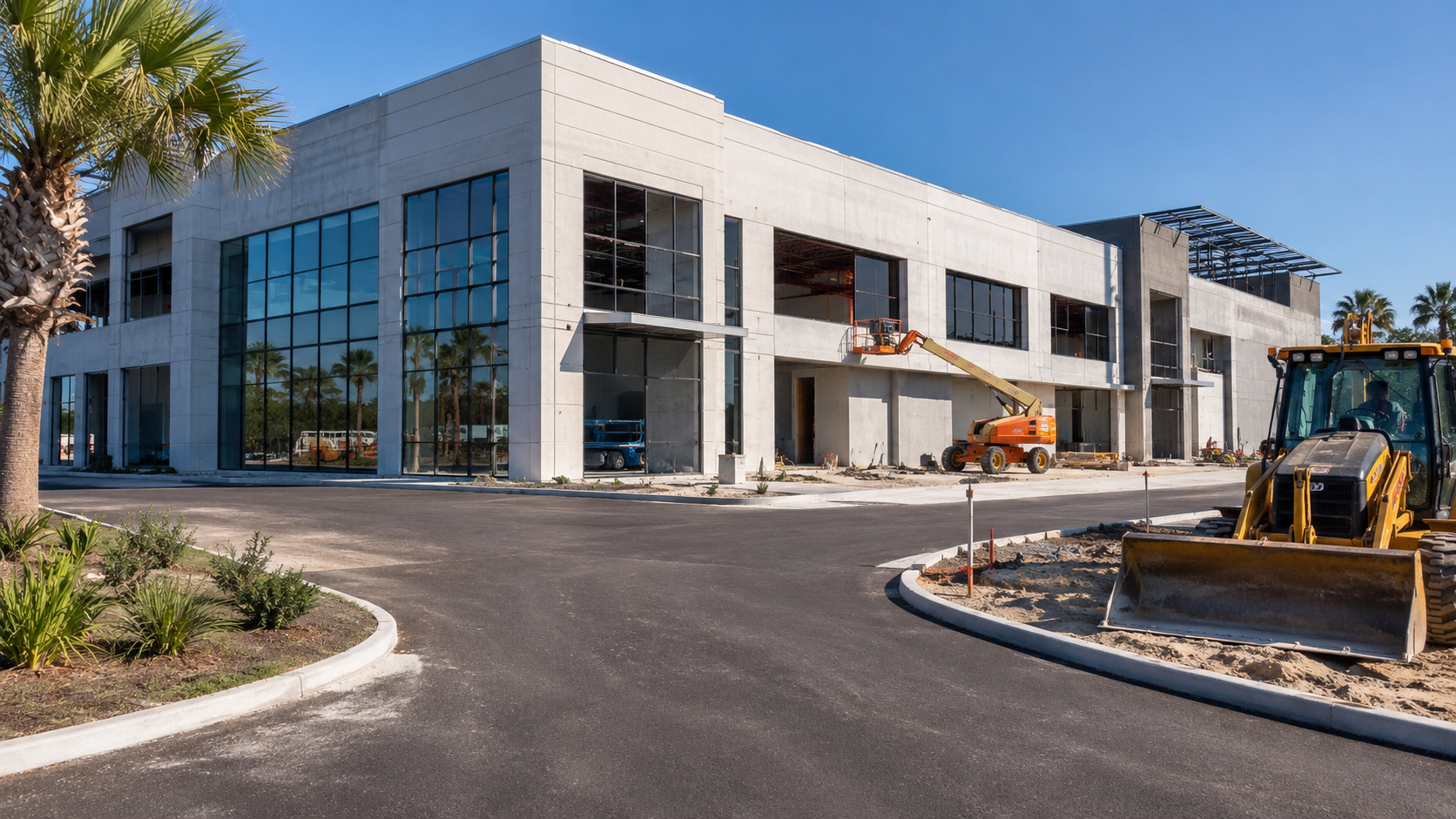
A Jacksonville business owner we met had two proposals for the same 6,000 sq ft flex building. One was $1.42 million. The other was $1.87 million. Same drawings, same site, same finish schedule. He assumed the cheaper commercial builder was simply hungrier for the work. Eleven months later the low bid had absorbed four change orders and finished above the higher number — and eight weeks late, which cost him a tenant.
The gap between those two proposals was not greed. It was scope. The expensive bid had priced things the cheap bid had left for later, and “later” on a commercial project is the most expensive place to discover a cost.
What a commercial builder charges in Northeast Florida
Ground-up commercial construction in the Jacksonville market generally lands between $180 and $310 per square foot for shell-and-core through tenant-ready. The spread is not a market inefficiency — it is real differences in structure, use group, and site.
- Warehouse and flex space — the low end. Simple envelope, minimal mechanical load, open spans.
- Retail and restaurant — the middle-to-high end, driven by grease interceptors, hood systems, and heavier electrical service.
- Medical and lab — the top of the range. Redundant power, specialized ventilation, and finish requirements that come with their own inspection regime.
Most builders quote a fee of 8–15% on top of hard costs. A lower fee is not automatically a better deal; it usually signals that supervision, warranty reserve, and closeout coordination have been priced thin, and those are exactly the functions that protect your opening date.
The four line items that decide your real number
Sitework. Northeast Florida soil is inconsistent. A geotechnical report that returns poor bearing capacity can add $40,000–$150,000 in undercut, fill, or pilings on an otherwise ordinary parcel. A builder who prices sitework as an allowance before soils are known is deferring risk to you, not absorbing it.
Stormwater and impact fees. Duval, Clay, and St. Johns each treat retention and concurrency differently. On a constrained lot, stormwater engineering and the pond it requires can consume land you assumed was leasable.
Wind-load structure. Coastal exposure categories drive connection hardware, roof attachment, and glazing ratings. A building three miles inland and one two miles from the water can carry materially different structural costs for the same footprint.
Permitting and review cycles. Budget calendar time, not just fees. A commercial permit that goes through two rounds of comments is normal; one that goes through five because drawings were incomplete is a schedule problem that turns into a carrying-cost problem.
How to read two bids that do not match
Ask every bidder to price the same clarified scope, then compare four things: the allowance schedule, the exclusions page, the general-conditions line, and the assumed schedule duration. Nearly every large bid gap lives in one of those four. A proposal with no exclusions page is not a cleaner proposal — it is an incomplete one.
The question worth asking is not “who is cheapest today” but “whose number will still be true at closeout.” A builder who has already walked your site, read the soils report, and priced the stormwater is quoting a project. A builder who has priced a square-foot average is quoting a guess.
Schedule is a cost line, even when nobody prices it
Owners tend to treat the construction schedule as a convenience issue and the budget as the real issue. On commercial work they are the same issue. Every month a building is not open carries loan interest, deferred rent, and in many cases a tenant with a lease commencement date written into a contract you have already signed.
That is why the general-conditions line deserves more attention than it usually gets. General conditions fund the superintendent, the trailer, temporary power, dumpsters, and the daily coordination that keeps twenty subcontractors sequenced correctly. A builder who trims that line to win the job has removed the mechanism that protects the date you actually care about. On a $1.5 million project, three weeks of avoidable delay typically costs more than the entire supervision savings that caused it.
Ask for a schedule with named milestones — permit issuance, slab, dry-in, mechanical rough, certificate of occupancy — rather than a single duration. A builder who can produce that sequence has thought through procurement lead times. Rooftop units, switchgear, and storefront glazing have all carried extended lead times in this market, and a builder who has not ordered long-lead equipment early is planning to be late regardless of how many crews are on site.
Where the money is actually saved
Real savings on commercial work come from decisions made before the slab is poured — building orientation that reduces mechanical load, a structural system matched to the span you actually need, and a finish schedule locked before procurement. Savings almost never come from cutting supervision or compressing the schedule, both of which reliably cost more than they save.
If you are still deciding what to build rather than who builds it, our commercial construction page walks through delivery methods and how each one allocates cost risk. For a market-rate comparison, see our breakdown of what a commercial construction contractor charges locally, and if you are still shortlisting firms, our guide to choosing commercial general contractors in Jacksonville covers the qualification questions that matter.
Verifying licensure is a two-minute step that prevents expensive problems: the Florida DBPR maintains a public license lookup for every contractor operating in the state. Ofir Engineering is a licensed Florida general contractor, License #CGC 1540016, building commercial and residential projects across Northeast Florida.
Keep Building With Ofir Engineering
Related discussions & follow us: Facebook · Reddit
Latest & related guides: Explore more Commercial Construction guides →